

Step on a smart scale, and within seconds it hands you a number that supposedly tells you how "old" your metabolism really is. For some people, that number is flattering. For others, it's alarming. Either way, most people walk away with more questions than answers, because the concept of metabolic age is simultaneously everywhere and poorly explained. This guide cuts through the noise, covering what metabolic age actually measures, how it's calculated, where it falls short, and how to use it intelligently as part of a results-driven wellness strategy.
Table of Contents
- What does metabolic age really mean?
- How metabolic age is measured: Behind the numbers
- Beyond BMR: Evolving frameworks for metabolic age
- How to use your metabolic age (and avoid common pitfalls)
- Why experts caution against obsessing over metabolic age
- Explore personalized metabolic optimization with Aurelia Method
- Frequently asked questions
Key Takeaways
| Point | Details |
|---|---|
| Metabolic age basics | Metabolic age estimates your body’s metabolic rate relative to your actual age, mainly using BMR data. |
| Measurement limitations | Consumer devices provide only directional value due to hydration and algorithmic variation. |
| Holistic frameworks | Newer approaches may include VO2 max and metabolic markers for a broader view, but there’s no universal standard. |
| Actionable use | Track metabolic age trends to inform your wellness protocol, but use expert guidance for meaningful change. |
What does metabolic age really mean?
Metabolic age is an estimated comparison between your basal metabolic rate (BMR) and the average BMR of people in your actual age group and gender. In plain terms, if your metabolism burns calories at a rate more typical of a 35-year-old but you're actually 45, your metabolic age is reported as 35. The appeal is obvious: a single number that seems to reveal how efficiently your body is running at rest.
For health-focused individuals tracking longevity, performance, and body composition, this kind of shorthand is attractive. It promises a fast read on metabolic health without requiring a clinical visit. Consumer smart scales, fitness apps, and wearables have made this metric widely accessible, which is part of why it's become a staple in biohacking circles.
Here's what typically drives interest in metabolic age:
- Longevity tracking: People want to know whether their lifestyle choices are slowing or accelerating biological aging at the metabolic level.
- Body composition goals: A lower metabolic age often correlates with higher lean muscle mass and lower fat percentage.
- Performance benchmarking: Athletes and high performers use it as one signal among many to gauge training adaptation.
- Biohacking feedback: For those running structured protocols, metabolic age can serve as a rough before-and-after indicator.
The catch is that metabolic age is derived from BMR calculations using consumer devices, and reliability can vary substantially. Many people see swings of 2 to 8 years between readings taken on the same day under slightly different conditions. That's not a minor rounding error. It's a signal that the number deserves careful interpretation.
Stat callout: Consumer device readings can shift by 2 to 8 years based on hydration status alone, which makes single-point readings far less meaningful than longitudinal trends.
How metabolic age is measured: Behind the numbers
Most consumer devices use bioelectrical impedance analysis (BIA) to estimate metabolic age. BIA works by sending a low-level electrical current through the body and measuring how it travels through different tissues. Fat mass resists the current more than lean mass and water, so the device builds an estimate of body composition, then feeds that into a BMR formula, and finally compares the result to population averages to generate a metabolic age score.

The method is fast, non-invasive, and inexpensive to build into a scale or handheld device. That's exactly why it's everywhere. But those same conveniences come with real measurement trade-offs.
| Measurement factor | How it affects metabolic age reading | Magnitude of impact |
|---|---|---|
| Hydration status | Dehydration increases resistance, skewing body fat estimates upward | High |
| Time of day | Fluid distribution shifts throughout the day | Moderate |
| Recent exercise | Temporarily alters fluid balance and muscle glycogen | Moderate to high |
| Body composition type | Highly muscular or lean individuals may not match reference populations | High |
| Device algorithm | Different brands use different reference databases and formulas | Variable |
| Recent food intake | Affects fluid and electrolyte balance | Moderate |
Results from consumer devices are influenced by hydration, device algorithm, and body composition mismatch relative to reference populations. This is particularly relevant for individuals with atypical physiques, such as competitive athletes, those who carry significant muscle mass, or anyone whose body composition falls outside the standard reference ranges the device was calibrated on.
Algorithmic differences between brands matter more than most users realize. Two scales from different manufacturers can produce metabolic age readings that differ by 5 to 10 years for the same person measured back-to-back. This isn't a flaw in one device. It's a reflection of the fact that there is no universal standard for how metabolic age should be calculated.
"The real value of BIA-based metabolic age is not in any single reading. It's in the pattern you build over weeks and months under controlled conditions."
Pro Tip: Always measure under the same conditions for more useful trend data. First thing in the morning, after using the bathroom, before eating or drinking, and without recent intense exercise. This won't make the absolute number more accurate, but it will make your trend line far more meaningful.
Beyond BMR: Evolving frameworks for metabolic age
The standard BMR-based approach is just the beginning. More sophisticated frameworks are emerging that treat metabolic age as a composite score rather than a single-variable estimate. These approaches pull in a broader set of physiological markers to build a more complete picture of metabolic health.
Some frameworks include VO2 max, insulin sensitivity, and metabolic markers, though these are not universally applied. The logic is sound: BMR alone tells you how much energy your body uses at rest, but it doesn't capture how efficiently your cells use fuel, how well your cardiovascular system delivers oxygen, or how your hormonal environment shapes energy regulation.
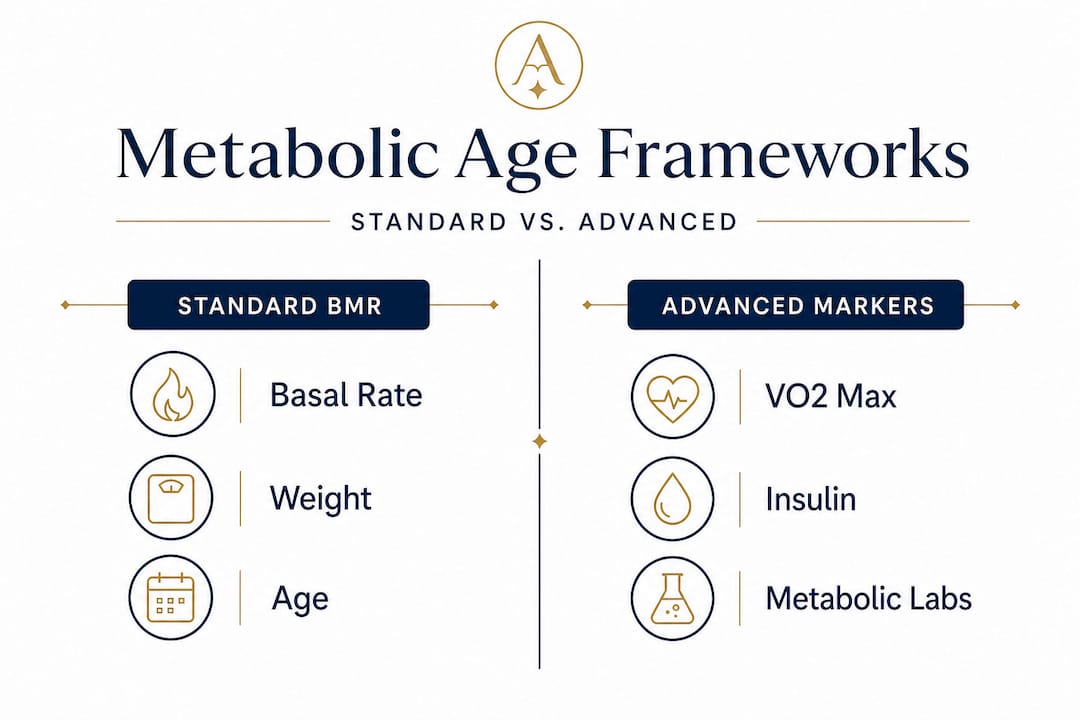
Here's a comparison of the two main approaches:
| Framework type | Primary inputs | Accessibility | Clinical relevance |
|---|---|---|---|
| Simple (BMR-based) | BMR estimate via BIA | Consumer scales, apps | Low to moderate |
| Advanced (composite) | VO2 max, insulin sensitivity, fasting glucose, HRV, lean mass | Clinical or advanced testing | Moderate to high |
The additional markers that matter most for a high-performance or longevity-focused protocol include:
- VO2 max: A strong predictor of cardiovascular fitness and long-term health outcomes, often more telling than BMR alone.
- Insulin sensitivity: Reflects how efficiently your cells respond to glucose signals, a core driver of metabolic function and fat storage.
- Fasting glucose and HbA1c: Provide context on blood sugar regulation over time.
- Heart rate variability (HRV): An indirect indicator of autonomic nervous system health and recovery capacity.
- Lean muscle mass percentage: Muscle is metabolically active tissue. More of it means a higher resting metabolic rate and generally a lower metabolic age.
The limitation here is significant. No single universal standard has been adopted by the scientific community for composite metabolic age scoring. Different research groups and wellness platforms define and weight these inputs differently, which makes cross-comparison difficult. What one protocol calls a metabolic age of 38 may reflect entirely different inputs than another's identical score.
For individuals running advanced wellness protocols, this is actually an opportunity. It means you can work with a specialist to define which markers are most relevant to your goals and build a personalized metabolic age framework that reflects your actual physiology rather than a population average.
How to use your metabolic age (and avoid common pitfalls)
Knowing what metabolic age is and how it's measured is only useful if you can translate that knowledge into smarter tracking and better decisions. Here's a practical approach.
Step-by-step tracking protocol:
- Standardize your measurement conditions. Same time of day, same hydration state, same device. Morning measurements before eating or drinking are most consistent.
- Record weekly, not daily. Daily fluctuations are noise. Weekly averages reveal signal.
- Log contextual variables. Note sleep quality, training load, and any significant dietary changes alongside your reading.
- Track trends over 8 to 12 weeks. That's the minimum window for meaningful directional data.
- Compare against other metrics. Pair metabolic age with body weight, lean mass percentage, resting heart rate, and energy levels for a fuller picture.
- Revisit your baseline quarterly. Seasonal changes in activity, diet, and stress can shift your metabolic baseline.
The most common mistake is treating a single reading as a verdict. Metabolic age as estimated by consumer devices should be taken as directional context, not a precise biomarker. The number itself is less important than whether it's moving in the right direction over time.
Integrating metabolic age into a holistic tracking system is where it becomes genuinely useful. When your metabolic age is trending down alongside improvements in lean mass, sleep quality, and energy output, you have a coherent story of positive metabolic adaptation. When it's drifting up despite other positive signals, that's a prompt to investigate further, not a cause for alarm.
Pro Tip: Use metabolic age as a motivation tool, not a diagnostic result. It's a directional indicator that can reinforce the value of consistent habits. When it improves, that's a signal your protocol is working. When it stalls or worsens, it's a cue to review inputs, not to panic.
When should you go deeper? If your metabolic age consistently reads significantly higher than your chronological age despite sustained effort, that's a reasonable trigger for a specialist consultation. A clinician or advanced wellness practitioner can order fasting insulin panels, comprehensive metabolic panels, DEXA scans for precise body composition, and VO2 max testing to build a far more accurate and actionable picture.
Why experts caution against obsessing over metabolic age
Here's the uncomfortable truth that most wellness content won't say directly: the marketing around metabolic age has significantly outpaced the science. Consumer device manufacturers have every incentive to make their metabolic age feature feel precise and authoritative. The reality is that it's a rough estimate built on population averages and a measurement method that is genuinely sensitive to variables you can't always control.
We've seen this play out repeatedly with clients who arrive frustrated because their metabolic age jumped five years overnight despite doing everything right. In almost every case, the culprit is a confounding variable, typically hydration, a hard training session the day before, or simply a different time of day for the measurement. The number didn't reflect a real metabolic shift. It reflected measurement noise.
Atypical body composition or hydration status can significantly skew metabolic age readings, making them unreliable for some high-performing individuals. This is especially true for people who carry above-average muscle mass, which is common among those running structured training and nutrition protocols. BIA devices are calibrated against general population reference data. If your physique sits outside those norms, your metabolic age score may be systematically biased in one direction regardless of your actual metabolic health.
The most effective approach we've seen combines consumer metrics like metabolic age with regular clinical markers, including fasting insulin, comprehensive blood panels, and body composition scans, and treats the whole picture as a dynamic, evolving dataset. No single number, whether it's metabolic age, weight, or even VO2 max, tells the full story. The clients who make the most consistent progress are the ones who build a personalized tracking framework and rely on their own longitudinal context rather than chasing any single algorithm's output.
The real value of metabolic age is as a motivational anchor and a rough trend indicator. When used that way, with appropriate skepticism and within a broader health optimization strategy, it earns its place in your toolkit. When treated as a clinical verdict, it creates unnecessary anxiety and misguided decisions.
Explore personalized metabolic optimization with Aurelia Method
Understanding your metabolic age is a starting point, not a destination. The real leverage comes from building a protocol that addresses the underlying drivers of metabolic function: body composition, hormonal signaling, cellular energy efficiency, and recovery capacity.

At Aurelia Method, we design science-backed, personalized protocols that go well beyond what any consumer scale can reveal. Our approach integrates advanced metabolic markers, peptide-based interventions, and individualized program design to move the needle on the metrics that actually matter for long-term performance and longevity. If you're ready to move from tracking a number to actively optimizing the biology behind it, our private consultation process is where that work begins.
Frequently asked questions
Is metabolic age a reliable indicator of my actual health status?
Metabolic age can reveal trends over time, but device readings fluctuate based on hydration and body composition factors, so they should be interpreted as directional rather than diagnostic.
Can metabolic age be improved with diet and exercise?
Yes. Positive changes to body composition and fitness, particularly building lean muscle mass, can lower your metabolic age score by improving underlying metabolic rate and related health markers.
Why does my metabolic age change so much between measurements?
Hydration levels, device algorithms, and day-to-day physiological variation all contribute to significant shifts. BIA-based age readings are especially sensitive to hydration status, which can change meaningfully within hours.
Are advanced frameworks for metabolic age more accurate?
Adding more health markers like VO2 max and insulin sensitivity improves context, but advanced frameworks lack uniform adoption and standardized validation across the scientific community, so accuracy still varies considerably.