

Body recomposition, the simultaneous loss of fat and preservation or gain of lean muscle, is one of the most sought-after outcomes in advanced wellness. Peptides have entered this space with real clinical momentum, yet the gap between published evidence and the protocols circulating online remains wide and sometimes dangerous. You deserve a clear picture of what the science actually supports, what requires medical oversight, and how to build a structured plan that produces visible, measurable results without gambling your health on unverified compounds.
Table of Contents
- What you need before starting peptide-assisted recomposition
- Step-by-step peptide-assisted recomposition protocol
- Common pitfalls and expert troubleshooting
- Measuring success: Metrics, timeframes, and realistic expectations
- Why most peptide-assisted body recomposition guides get it wrong
- Trusted clinical guidance for peptide-enhanced recomposition
- Frequently asked questions
Key Takeaways
| Point | Details |
|---|---|
| Evidence-based planning | Only consider protocols with clear evidence, medical oversight, and safety monitoring for body recomposition using peptides. |
| Dual focus approach | Combine peptide interventions with resistance training and adequate protein to maximize fat loss while preserving muscle. |
| Track and verify | Use objective metrics such as DEXA scans and periodic reassessment to verify meaningful progress. |
| Beware non-FDA peptides | Treat non-approved peptides as investigational and ensure any use is under experienced clinical guidance. |
| Expect realistic outcomes | Expect gradual, measurable improvements—most protocols show results within 3-6 months, not overnight. |
What you need before starting peptide-assisted recomposition
Once you understand why evidence matters, the next step is preparing with the right clinical and peptide groundwork.
Starting without proper preparation is the fastest route to wasted time, wasted money, and potential harm. Before any peptide enters your protocol, you need a medical baseline that gives your clinician a clear picture of your current metabolic status, hormonal environment, and cardiovascular health. This is not bureaucratic box-checking; it is the foundation that makes your entire program safe and interpretable.
Recommended baseline labs before beginning any protocol:
- Fasting glucose and HbA1c (critical for GH-axis and GLP-1 peptides)
- Fasting insulin and HOMA-IR
- Full lipid panel with LDL particle sizing
- Comprehensive metabolic panel (liver and kidney function)
- IGF-1 (for GH-axis peptide users)
- Thyroid panel (TSH, free T3, free T4)
- Sex hormone panel (testosterone, estradiol, SHBG, LH, FSH)
- DEXA or CT baseline scan for segmental body composition
- Blood pressure and resting heart rate
These results are not optional. They are the data points that allow your clinician to select the right peptide class, set appropriate dosing, and flag changes that require intervention.
Peptide classes relevant to body recomposition:
The two most clinically supported categories for fat reduction are GLP-1 receptor agonists and GH-axis peptides like tesamorelin. GLP-1 receptor agonists carry a recognized lean mass risk, which is why clinicians strongly recommend pairing them with resistance training and adequate protein from day one rather than relying on pharmacology alone. The research is clear on this point: pharmacotherapy without muscle-preserving strategies leads to a composition shift you do not want.
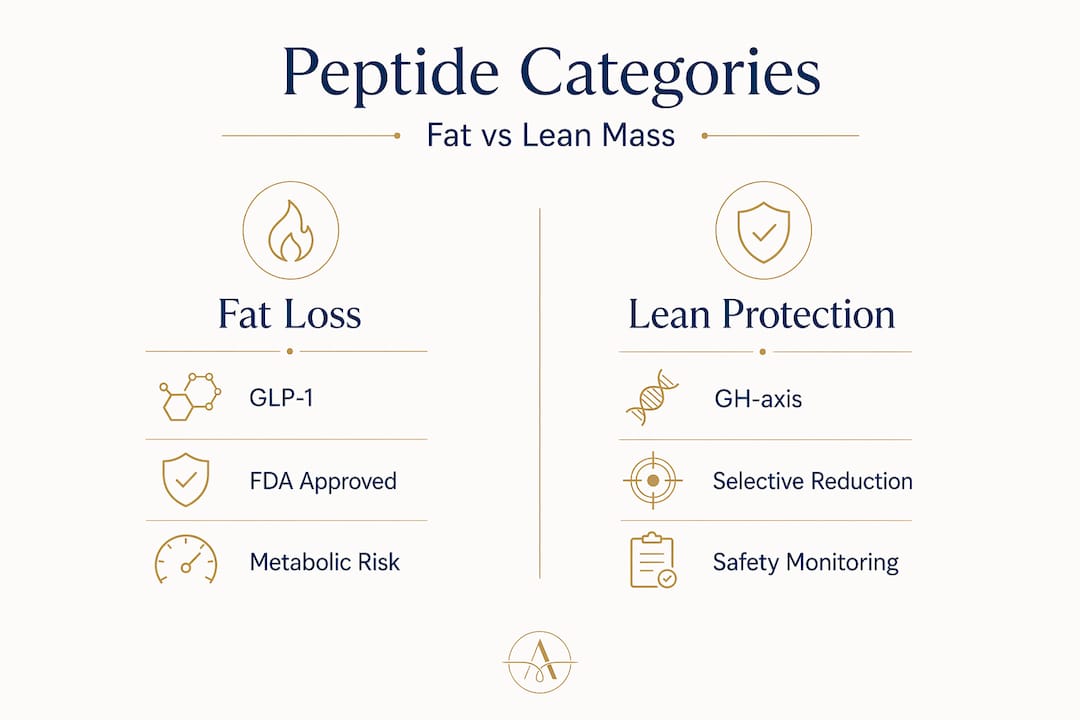
For the GH-axis, tesamorelin's pivotal Phase 3 data shows selective visceral fat reduction with carefully monitored safety endpoints. It is FDA-approved for HIV-associated lipodystrophy, meaning its evidence base is deep and its monitoring requirements are well-defined. Non-FDA peptides do not carry the same level of documented clinical support, and their use requires even more rigorous oversight.
Working within evidence-based frameworks separates medically sound recomposition from the kind of trial-and-error protocols that produce inconsistent outcomes.

| Peptide class | Primary mechanism | FDA status | Key monitoring need |
|---|---|---|---|
| GLP-1 receptor agonists | Appetite suppression, glucose regulation | Approved (obesity, T2D) | Lean mass, GI symptoms |
| Tesamorelin | GHRH analogue, visceral fat reduction | Approved (HIV lipodystrophy) | Glucose, IGF-1, joint symptoms |
| Non-FDA research peptides | Variable, often GH-secretagogue | Not approved | All parameters, investigational |
Pro Tip: Before finalizing your peptide selection, confirm that your clinician has specified not just starting dose but also titration schedule, monitoring frequency, and a post-cycle reassessment timeline. A protocol without those parameters is incomplete.
Step-by-step peptide-assisted recomposition protocol
With the right prerequisites in place, you can follow a structured, safest-path protocol.
This blueprint integrates pharmacological, nutritional, and training variables together because none of them work in isolation. Think of the peptide as a metabolic signal, the training as the structural stimulus, and the nutrition as the substrate. All three must align.
Step-by-step protocol outline:
-
Medical onboarding (week 1-2): Complete all baseline labs. Review personal health history with a qualified clinician. Confirm contraindications. Establish monitoring schedule and set body composition benchmarks using DEXA or CT.
-
Peptide selection and initiation (week 2-3): Choose peptide class based on primary goal, health status, and clinician guidance. GLP-1 agonists are appropriate for significant visceral fat reduction in metabolically compromised individuals. GH-axis peptides like tesamorelin are considered in select clinical contexts. For most healthy adults pursuing recomposition, the evidence supports prioritizing medical and nutritional strategies alongside any pharmacological agent.
-
Resistance training integration (week 1 onwards): Do not wait to start training. Initiating resistance work at the same time as peptide commencement is a widely recommended strategy in clinical discussion, because the anabolic stimulus from training counteracts the lean mass risk from GLP-1 therapy specifically. Target 3-4 sessions per week with compound movements.
-
Protein and caloric targets: Aim for a minimum of 1.6 grams of protein per kilogram of body weight, with many practitioners targeting up to 2.2 grams per kilogram during active fat loss phases. This is not a suggestion; lean-mass preservation depends on it. Total caloric intake should reflect a moderate deficit of 300-500 calories daily when fat loss is the primary goal.
-
Monthly reassessment (months 1, 3, 6): Re-run key labs including fasting glucose, IGF-1 if on GH-axis peptides, and a body composition scan. Compare results against baseline. Adjust dosing or training stimulus based on objective data, not subjective feel.
-
Protocol review at 6 months: Evaluate whether continuation, modification, or discontinuation is appropriate. A 2026 meta-analysis of GLP-1 receptor agonists confirms meaningful fat mass reduction in overweight adults, but outcomes for non-FDA-approved peptides remain uncertain across most body composition goals in healthy individuals.
Comparison: major peptide categories for recomposition
| Peptide | Fat loss evidence | Lean mass risk | Clinical evidence quality | Supervision requirement |
|---|---|---|---|---|
| GLP-1 agonists | Strong (FDA-approved populations) | Moderate without training | High (RCTs, meta-analyses) | Mandatory |
| Tesamorelin | Strong for visceral fat | Low | High (Phase 3 RCTs) | Mandatory |
| Non-FDA research peptides | Limited and inconsistent | Unknown | Low to very low | Mandatory + caution |
Pro Tip: Start exercise and dietary changes on the same day you begin your peptide, not after. The protective effect on lean mass is dose-dependent on how early you establish that training stimulus.
Common pitfalls and expert troubleshooting
Even with a well-designed plan, complications can arise, so here's how to stay safe and effective.
The most common mistake we see is treating peptides as a primary intervention and lifestyle as secondary. That inversion almost always produces disappointing results, or worse, a body composition outcome that looks worse on a DEXA scan than when you started. Fat mass drops but lean mass follows it down when training and protein are neglected.
Pitfalls to anticipate and fix:
- Muscle loss without adequate protein: If your protein intake drops below 1.5 grams per kilogram of body weight during GLP-1 therapy, lean mass loss risk becomes clinically significant. Fix: Recalculate and track protein daily, not weekly.
- Skipping resistance training: Cardio alone will not preserve muscle during active fat loss. Fix: Add compound resistance work at least 3 times per week regardless of energy levels.
- Over-relying on anecdotal dose guidance: Online forums are not clinical data. Non-standard dosing creates unpredictable GH and IGF-1 fluctuations. Fix: Follow your clinician's protocol strictly.
- Ignoring early side effect signals: Mild side effects often resolve, but specific symptoms need prompt reporting. Fix: Log symptoms daily for the first 8 weeks.
- Skipping follow-up labs: You cannot assess what you do not measure. Fix: Book 30-day labs before your peptide refill, not after.
Important safety notice: GH-axis peptides, including tesamorelin, carry documented risks of arthralgias and edema according to meta-analyses of randomized controlled trials. Glucose monitoring is essential throughout, as GH-axis stimulation can impair insulin sensitivity. Medical supervision is not optional for these compounds.
The frustration most people feel around the 6-week mark, when results seem to plateau, usually traces back to one of these issues rather than peptide inefficacy. Troubleshoot systematically before changing compounds.
Measuring success: Metrics, timeframes, and realistic expectations
Successfully navigating the protocol means knowing exactly how to measure true progress and safety.
A bathroom scale tells you almost nothing useful in a recomposition context. Weight can stay stable while significant fat loss and lean mass gain are both occurring simultaneously. This is why objective imaging is the gold standard.
Tracking tools ranked by accuracy:
- DEXA scan: Segments fat mass, lean mass, and bone density regionally. Reproducible and cost-effective for quarterly monitoring.
- CT scan: The gold standard for visceral adipose tissue specifically. Most relevant if tesamorelin or GLP-1 protocols target visceral fat.
- Circumference measurements: Waist, hip, and thigh measurements provide a simple and inexpensive proxy for regional fat change between scans.
- Strength performance logs: Progressive overload data from your training sessions is a direct proxy for lean mass preservation and neuromuscular function.
Expected changes by timeframe:
| Timeframe | Fat mass changes | Lean mass changes | Key risks to monitor |
|---|---|---|---|
| 1 month | 1-2% reduction, modest | Minimal change or slight gain | GI side effects (GLP-1), joint symptoms (tesamorelin) |
| 3 months | 3-5% reduction | Stable to slight increase with training | IGF-1 elevation, glucose changes, muscle loss if undertrained |
| 6 months | Up to 6% fat body mass decrease | Lean body mass down ~1%, skeletal muscle down ~3% without proper training | Cumulative metabolic markers, sustained side effect monitoring |
Those 6-month figures come directly from a 2026 GLP-1 meta-analysis, which also noted visceral adipose tissue reductions that compound over time. Separately, tesamorelin Phase 3 data showed a 15.2% reduction in visceral adipose tissue versus a 5.0% increase in the placebo group, a difference that is metabolically significant well beyond aesthetics.
Red flags that require immediate clinical review:
- Excessive fatigue or rapid strength loss over 2 or more weeks
- Swelling in hands, feet, or joints that does not resolve within a few days
- Disproportionate muscle loss confirmed by scan or visual assessment
- Fasting glucose rising above your baseline range
- Unexplained changes in sleep quality or mood stability
Why most peptide-assisted body recomposition guides get it wrong
Most guides circulating online share a structural flaw: they extrapolate from disease-specific trial data to healthy adults without acknowledging the gap. The tesamorelin data, for example, comes from HIV-associated lipodystrophy patients who have a distinct pathophysiological context. GLP-1 agonist data comes primarily from individuals with obesity or type 2 diabetes. Applying those outcomes directly to a metabolically healthy 40-year-old who wants to drop 8% body fat is a significant logical leap.
This matters because risk profiles shift when you move outside the trial population. Side effects that were acceptable in a disease treatment context carry different weight when the intervention is elective. The cautious, evidence-aligned stance treats most non-FDA-approved peptides as investigational for body composition goals unless you have clinician-guided monitoring and transparent measurement through DEXA, CT scans, and strength tracking.
What separates outcomes that hold up over time is not which peptide you use. It is whether you have continuous, objective data informing every decision. Anecdotal success stories from forums do not tell you about the people who lost significant muscle, developed insulin resistance, or experienced adverse joint symptoms that went unmonitored. You only hear the positive results, which creates a heavily skewed picture of what is typical.
Our perspective is that body recomposition through any pharmacological aid requires treating the body as a measurable system. The peptide is a variable, not a solution. Real results come from layering clinical oversight, matched training stimulus, and iterative data review. The evidence-based frameworks that produce consistent outcomes are not exciting enough for most guides to publish, because they require patience, professional support, and honest metrics. That is precisely what separates them from the protocols that disappoint.
Trusted clinical guidance for peptide-enhanced recomposition
Navigating peptide selection, dosing, and monitoring alone is how most protocols produce mediocre results or avoidable complications. The Aurelia Method is built around exactly the rigor this kind of program demands: private consultations, bespoke protocol design, and ongoing clinical monitoring that tracks every variable from lab values to body composition scans.

If you are ready to move beyond generic protocols and into a program calibrated to your specific metabolic profile, our team can build a plan that integrates personalized peptide protocols with nutritional structure and professional oversight from day one. Every Aurelia Method program includes baseline assessment, structured reassessment milestones, and direct access to expert guidance throughout. Real recomposition results are measurable. Start measuring yours correctly.
Frequently asked questions
How quickly will I see body recomposition results with peptides?
Most individuals see noticeable fat loss and modest lean mass changes within 3 to 6 months when protocols are supervised and paired with consistent resistance training and adequate protein intake, consistent with GLP-1 meta-analysis findings showing significant fat mass decreases over that window.
Are all peptides for body recomposition FDA-approved?
No; only select compounds carry FDA approval for fat and body composition changes, and tesamorelin's FDA status applies specifically to HIV-associated lipodystrophy, not general recomposition goals in healthy adults.
Can I rely on peptides alone for muscle gain?
Relying on peptides without resistance training actively risks lean mass loss, particularly with GLP-1 therapy where muscle loss risk is well-documented unless paired with consistent exercise and a high-protein diet.
What are the main risks of peptide protocols for recomposition?
Key risks include muscle loss, joint pain, edema, and adverse metabolic shifts, with tesamorelin trials specifically reporting arthralgias and edema as statistically significant side effects even in controlled clinical settings.
Do I need specialized scans to track my progress?
DEXA or CT scans are the most accurate tools for tracking true body composition changes during peptide protocols, and the evidence-aligned clinical standard treats transparent imaging-based measurement as essential for anyone using investigational compounds.