

You've done the diet. You lost the weight. But somewhere in the process, you also lost the muscle that made you look and feel athletic, and now you're softer, slower, and right back where you started. This cycle is frustratingly common, and it happens because most fat loss approaches treat the body like a simple math equation. Body recomposition is achieved through a modest calorie deficit of 100 to 500 kcal below maintenance, high protein intake of 1.2 to 2.2 g/kg body weight, and resistance training two to four times per week with progressive overload. This guide gives you the exact framework to lose fat without sacrificing the muscle you've worked hard to build.
Table of Contents
- What you need for muscle-sparing fat loss
- Step-by-step: Building your muscle-sparing fat loss timeline
- Troubleshooting and common mistakes
- How to track progress and verify results
- Why muscle-sparing timelines outperform standard diets
- Personalize your muscle-sparing transformation
- Frequently asked questions
Key Takeaways
| Point | Details |
|---|---|
| Calorie and protein targets | A modest calorie deficit and high-protein diet are essential for preserving muscle during fat loss. |
| Training is non-negotiable | Consistent resistance training is critical to prevent muscle loss during any fat loss phase. |
| Peptide protocols can help | Advanced peptide strategies offer an edge for muscle retention but are most effective when used with fundamentals. |
| Track beyond the scale | Use measurements, photos, and strength levels to verify true progress instead of relying only on weight. |
What you need for muscle-sparing fat loss
With the risks of losing muscle clear, your game plan requires the right gear and foundational choices before you take a single step.

Most people jump straight into a calorie deficit without assembling the tools or baselines that actually make the difference between losing fat and losing everything. Think of this phase as loading your toolkit. Without the right instruments, you're guessing, and guessing costs muscle.
Here's what you need in place before starting:
- A reliable scale for weekly body weight trends (not daily obsession)
- A calorie and protein tracking app such as Cronometer or a similar food logging tool
- Access to resistance training either at a gym or with sufficient home equipment for progressive overload
- A peptide protocol if you're incorporating advanced support, such as CJC-1295/Ipamorelin, which boosts growth hormone to support muscle preservation and fat loss over 12 to 16 week cycles
- Self-assessment tools including a tape measure, progress photo setup, and a strength log
The contrast between a traditional fat loss approach and an optimized muscle-sparing setup is significant. Here's how they compare:
| Prerequisite | Traditional fat loss | Muscle-sparing approach |
|---|---|---|
| Calorie deficit | Often 500-1000+ kcal | Controlled 100-500 kcal |
| Protein target | Rarely tracked | 1.2-2.2 g/kg body weight |
| Resistance training | Optional or cardio-focused | Non-negotiable, 2-4x/week |
| Progress tracking | Scale weight only | Scale + measurements + photos + strength |
| Peptide support | Not used | Optional but strategic layer |
| Cycle length | Undefined | Structured 12-16 week blocks |
Your baseline steps before week one begins:
- Calculate your maintenance calories using a TDEE calculator and your actual activity level, not the generic "sedentary" setting most people default to
- Set your macro targets: protein first, then fill remaining calories with carbohydrates and fats based on preference and training demands
- Choose your resistance training schedule and write it into your calendar like an appointment you cannot cancel
- Decide whether you're incorporating body composition protocols with peptide support, and if so, confirm your cycle start date and sourcing
Pro Tip: Stop relying on the scale as your primary feedback tool. Take progress photos every two weeks under consistent lighting and the same time of day, and measure your waist, hips, chest, and arms. The scale can stay flat or even rise while you're actively losing fat and gaining muscle. Photos and measurements will show you what the scale hides.
Step-by-step: Building your muscle-sparing fat loss timeline
Once you have your essentials assembled, here's how to structure your actual muscle-sparing fat loss timeline for maximum results.
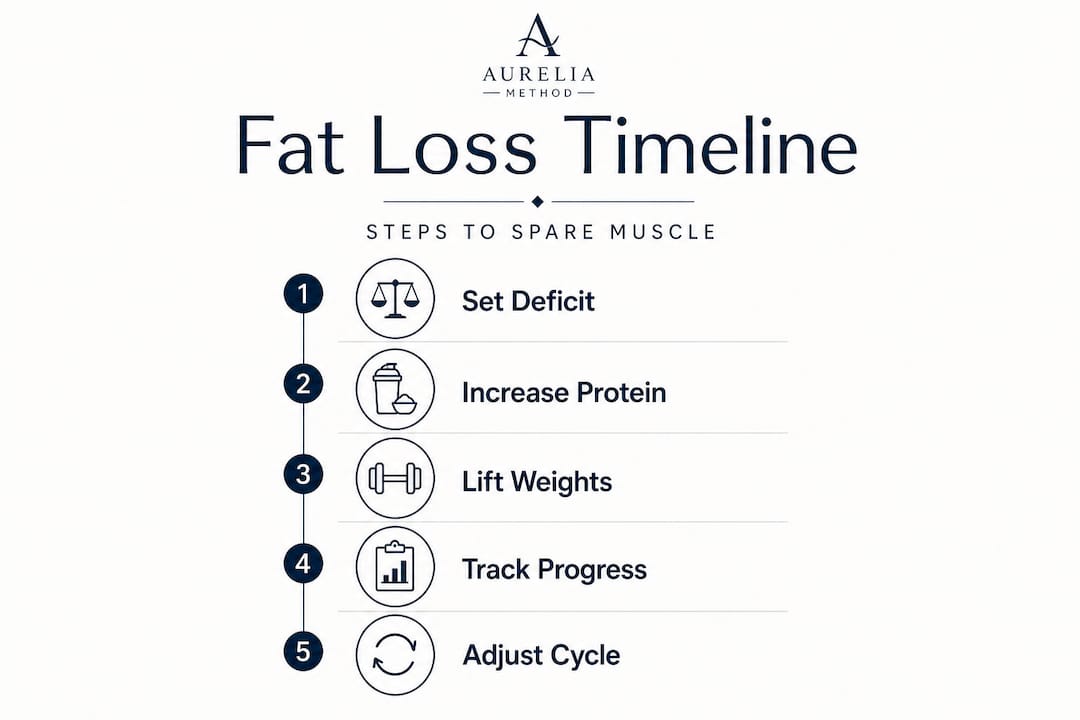
This isn't about following a generic 12-week program you found online. It's about building a sequenced, personalized timeline where each phase feeds into the next. Here's the exact process:
-
Map your start point. Record your current body weight, take measurements, photograph yourself from front, side, and back, and log your current strength on key lifts like squat, deadlift, and bench press. This baseline is your reference for everything that follows.
-
Calculate your deficit. Use your TDEE as the anchor. Subtract 100 to 500 kcal depending on how aggressively you want to move. A modest calorie deficit in this range supports fat loss while preserving lean mass. Larger deficits increase the risk of muscle catabolism, especially without adequate protein.
-
Set your protein target with real math. If you weigh 80 kg, your minimum target is 96 g of protein per day (1.2 g/kg), and your optimal range runs up to 136 g per day (1.7 g/kg). Research confirms that 1.2 to 1.7 g/kg is sufficient for fat-free mass retention during energy restriction, with higher intakes showing no additional benefit in controlled studies.
-
Plan your resistance training days. Schedule at minimum two sessions per week, ideally three to four. Each session should include compound movements that drive progressive overload. Add weight, reps, or sets over time. Stagnation in the gym often signals that your deficit is too aggressive or your protein is too low.
-
If using peptides, map your protocol start and end. CJC-1295 paired with Ipamorelin is a well-documented combination for growth hormone stimulation. Initial effects on body composition typically appear within four to twelve weeks, with full cycle benefits realized at the twelve to sixteen week mark. Build this window into your overall timeline so you know exactly when to assess outcomes and when to plan a break.
Here's how results typically differ between a traditional approach and a peptide-supported muscle-sparing protocol:
| Timepoint | Traditional fat loss | Peptide-supported approach |
|---|---|---|
| Week 4 | Scale drops, possible muscle loss begins | Fat loss initiated, GH elevation begins supporting muscle |
| Week 8 | Plateau common, energy declining | Continued fat loss, muscle retention more stable |
| Week 12 | Muscle loss likely, metabolic adaptation | Noticeable recomposition, strength maintained or improved |
| Week 16 | Rebound risk high | Cycle complete, results consolidated with proper transition |
Pro Tip: Never push your deficit below 100 kcal or above 500 kcal during a muscle-sparing phase. Going lower might feel like faster progress, but it accelerates muscle breakdown and triggers metabolic adaptation that makes future fat loss harder. Slow and controlled always wins over aggressive and unsustainable.
For peptide users, the 12 to 16 week cycle window is standard because growth hormone pulses take time to meaningfully shift body composition. You're not looking for a two-week fix. You're building a biological environment that favors fat oxidation and muscle protein synthesis simultaneously. Rushing this process defeats the purpose of using peptides in the first place.
Troubleshooting and common mistakes
With your plan underway, sidestep these pitfalls to protect your muscle and momentum.
Even well-designed protocols fall apart when a few key mistakes creep in. Here are the most common ones, and how to course-correct before they derail your results:
- Going too low on calories. Cutting more than 500 kcal below maintenance accelerates muscle breakdown. If you're losing more than one pound per week consistently, tighten your deficit.
- Insufficient protein. Missing your daily protein target even by 20 to 30 grams consistently adds up to significant lean mass loss over a 12-week cycle. Track it daily, not just on good days.
- Skipping resistance training. Cardio alone does not preserve muscle during a deficit. Resistance training sends the anabolic signal that tells your body to hold onto lean tissue even when calories are low.
- Relying on scale weight only. The scale is one data point, not the whole story. Chasing a number without tracking measurements and strength leads to poor decisions like cutting calories further when the real issue is water retention or muscle gain offsetting fat loss.
- Neglecting sleep and recovery. Growth hormone is primarily released during deep sleep. If you're running a peptide protocol and sleeping five hours a night, you're actively undermining the mechanism you're trying to leverage.
Safety warning: Research shows that 25 to 40% of weight lost on GLP-1 medications can be lean mass without proper intervention. Resistance training two to three times per week and protein intake of 1.2 to 1.6 g/kg are the primary safeguards against this outcome. Without them, you're not just losing fat.
If your progress stalls or you notice strength declining over two or more consecutive weeks, it's time to reassess. Check your protein intake first, then your training volume, then your deficit size. In most cases, mitigating muscle loss comes down to one of these three variables being off. Adjust one at a time so you can identify what's actually driving the problem.
How to track progress and verify results
After implementing your timeline, your next focus is objective monitoring so you know your muscle is protected as fat comes off.
Tracking is where most people either overcomplicate things or abandon the process entirely. The goal is consistent, repeatable data collection every two to four weeks, not daily obsession.
Here's what to monitor throughout your cycle:
- Gym strength: Are you maintaining or improving your key lifts? Strength is the most direct indicator that muscle is being preserved.
- Body measurements: Waist, hips, chest, arms, and thighs measured every two weeks give you a clearer picture than weight alone.
- Progress photos: Front, side, and back under consistent conditions. Visual changes often appear before measurements shift significantly.
- Energy levels: Persistent fatigue, brain fog, or declining motivation are early signs that your deficit is too aggressive or your nutrition is off.
- Subjective markers: Sleep quality, mood, libido, and gym performance are all sensitive to the hormonal environment your protocol creates.
Check in on these markers every two to four weeks rather than daily. Daily tracking creates noise. Bi-weekly or monthly snapshots reveal genuine trends.
One critical risk to understand is what researchers call catch-up fat. Weight cycling raises the risk of sarcopenic obesity through muscle loss and accelerated fat regain. When you lose muscle during a diet and then regain weight, a disproportionate amount of that regained weight is fat, not muscle. This is why tracking muscle retention isn't just about aesthetics. It's about protecting your metabolic health for the long term.
Prioritize muscle mass measures over scale weight. If your weight is stable but your waist is shrinking and your lifts are improving, you're doing exactly what the protocol is designed to do.
Why muscle-sparing timelines outperform standard diets
Numbers tell part of the story, but here's what most people miss about the real impact of muscle-focused fat loss.
The fitness and wellness industry has a bias toward fast results. Thirty-day challenges, aggressive cuts, and dramatic before-and-after photos sell. But the physiology doesn't care about marketing timelines. What we've seen consistently is that short-term fat loss achieved at the expense of muscle creates a worse metabolic baseline than where the person started.
When you lose muscle, your resting metabolic rate drops. You burn fewer calories at rest. Your insulin sensitivity decreases. Your body becomes more efficient at storing fat. This is the hidden cost of crash dieting that never shows up in the headline number on the scale.
Muscle-sparing approaches are slower by design. A 12 to 16 week cycle with a modest deficit, high protein, and structured resistance training might produce less total weight loss than an aggressive eight-week crash diet. But the quality of that weight loss is fundamentally different. You keep the tissue that drives your metabolism, maintains your athleticism, and shapes your physique.
The contrarian insight worth sitting with is this: advanced protocols like peptides should be layered on top of foundational habits, not used as a replacement for them. Peptides amplify a well-structured body recomposition experience. They don't rescue a poorly structured one. If your protein is low, your training is inconsistent, and your deficit is too aggressive, adding CJC-1295/Ipamorelin won't fix the underlying problem. It will just make a mediocre protocol slightly less mediocre.
The clients who achieve the most durable transformations are the ones who treat the fundamentals as non-negotiable and use advanced tools to optimize what's already working. That's the real competitive edge of a muscle-sparing timeline.
Personalize your muscle-sparing transformation
Ready to go beyond the basics? Here's how to level up your fat loss timeline with expert direction and support.
Knowing the framework is one thing. Executing it with precision, especially when you're navigating peptide protocols, individualized macro targets, and training periodization simultaneously, is where personalized guidance makes a measurable difference.

At Aurelia Method, we build muscle-sparing fat loss programs around your specific physiology, goals, and timeline. From your initial assessment through your full 12 to 16 week cycle, every variable is calibrated to your body, not a generic template. Our private consultations cover peptide protocol design, nutrition structure, training alignment, and progress monitoring so you're never guessing whether your muscle is protected. If you're serious about losing fat without losing what makes you strong, this is where your next step begins.
Frequently asked questions
How long does a muscle-sparing fat loss cycle typically last?
Most muscle-sparing fat loss protocols run 12 to 16 weeks for best results, particularly when peptide cycles like CJC-1295/Ipamorelin are incorporated to support growth hormone output and lean mass retention.
What is the minimum protein intake to spare muscle during fat loss?
1.2 to 1.7 g/kg of body weight daily is the evidence-backed optimal range for preserving fat-free mass during calorie restriction, with higher intakes offering no additional benefit in controlled research.
Can you do muscle-sparing fat loss without peptides?
Yes. A modest deficit with resistance training and adequate protein preserves muscle effectively without peptide support, though peptides can accelerate and enhance outcomes when layered on a solid foundation.
Why does scale weight sometimes stall or increase during muscle-sparing fat loss?
Simultaneous muscle gain and fat loss can offset each other on the scale, which is why body measurements and strength tracking give you a far more accurate picture of what's actually happening in your body.
What's the biggest risk if I cycle my weight frequently?
Frequent weight cycling significantly raises the risk of sarcopenic obesity, a condition where repeated muscle loss followed by preferential fat regain leaves you with less metabolically active tissue and a higher body fat percentage over time.